





Key Takeaways |
|---|
|
Building a career in real estate sounds thrilling, but it’s also one of the toughest, most regulated industries to break into. BCFSA received 1,890 complaints and closed 2,077 cases in a single year, with real estate-related complaints rising 14%. This shows that the public is watching agents more closely than ever, and the rules are strict.
For new agents, passion alone isn’t enough. You need to manage money wisely, follow BCFSA rules carefully, build a personal brand that stands out, and stay strong when things don’t go your way.
Here we’ll walk you through the seven most common mistakes new agents in BC make and give you simple, practical tips to avoid them—so you can build a career that lasts.
The Financial & Compliance Foundation
Mistake 1: Under‑Capitalization & Missing the 3‑3‑3 Rule
The reality is that new real estate agents in Canada earn $20,000–$40,000 in their first year, while average living expenses often exceed $60,000 annually (Numbeo, SimforCanada). Without proper financial planning, most agents burn out before their first deal closes.
What New Agents Do Wrong
Launch without runway: They start without 6–12 months of financial runway, forgetting about the 45-day income lag after closing
Underestimate costs: They ignore licensing ($500–$1,000), insurance ($1,200–$2,400/year), MLS/tech ($200–$500/month), and marketing ($2,000–$5,000)
Tax blindness: They fail to set aside of gross commissions for self-employment taxes, per Canada Revenue Agency (CRA) guidelines
Ignore the 3-3-3 Rule: They lack 3 months of emergency savings, 3 months of mortgage reserves, and 3 property comparisons for market knowledge
Why It Matters
Financial stress is the #1 reason agents quit. One failed closing or unexpected expense derails the entire career. Agents without a runway are forced to chase every deal desperately—and desperation shows.
How to Avoid It
Plan for 12 Months: Write a simple business plan. Estimate realistic income, use the 80/20 rule (20% of tasks bring 80% of results), and note your break‑even point.
Know Your Startup Costs:
Cost Category | Low Estimate | High Estimate |
|---|---|---|
Licensing (BCFSA/MLS fees) | $500 | $1,000 |
Insurance (Errors & Omissions) | $1,200 | $2,400 |
MLS/Tech subscriptions | $200/month | $500/month |
Initial marketing (cards, signs, website) | $2,000 | $5,000 |
Total First-Year Estimate | $15,000 | $25,000 |
Build a Financial Cushion: Save at least 6 months of living expenses before you start, so you don’t feel pressured to close deals too quickly.
Use the 5 P’s of Marketing: Focus on Product, Price, Place, Promotion, and People to guide your branding and outreach.
Set Clear Milestones: Aim for your first deal by month 3, a healthy pipeline by month 6, and break‑even by month 12.
Note: In British Columbia, the Real Estate Services Act (RESA) requires agents to maintain trust accounts and follow strict financial recordkeeping guidelines. The BC Financial Services Authority (BCFSA) penalizes financial misconduct heavily. New agents must understand their compliance obligations before launching. Poor financial records aren't just bad business—they're violations that can cost you your license. |
Personal Branding & Client Acquisition Strategy
Mistake 2: Assuming “The Brokerage Will Send Me Clients”
The truth is, most successful agents built their business through referrals, sphere farming, or specialized niches—NOT through brokerage handouts.
What New Agents Do Wrong
Depend entirely on brokerage leads (which rarely materialize for rookies)
Lack a specific niche or specialization (trying to serve everyone = serving no one)
Don't build a personal brand or local online presence
Miss applying the 5 P's of Real Estate Marketing strategically
Why It Matters
Brokerage leads are finite and typically go to veteran agents with track records. If you're counting on them, you'll starve before you're established.
How to Avoid It
Pick Your Niche (First 30 Days): Choose a clear focus—like first‑time buyers in Vancouver, luxury homes, downsizers, or immigrant families.
Boost Your Local SEO: Set up and optimize your Google Business Profile, create agent landing pages, write neighborhood guides, and post property walkthrough videos.
Plan Your Prospecting (90 Days): Schedule daily outreach—cold calls, door knocking, social media posts, and attending local events.
Share Expert Content: Publish blog posts, market updates, buyer guides, and video tours to show you know your area and build trust.
Time Management & the 80/20 Rule
Mistake 3: Spending 80% of Time on Low‑Value Activities
What New Agents Do Wrong
Spend 80% of time on low-value admin tasks (data entry, scheduling, paperwork, email)
Chase every lead instead of qualifying prospects for buyer readiness
Fail to block time for high-impact activities (client meetings, property showings, negotiations)
Work reactively (responding to emails) instead of proactively (generating leads)
Why It Matters
Time is your scarcest resource. Agents who reverse the 80/20 rule—spending 20% on admin, 80% on client-facing work—fast-track to six figures.
How to Avoid It
Step 1 – Golden Hours: Block 9 AM–1 PM daily for client‑facing work only—no emails, no admin, no distractions.
Step 2 – CRM Tools: Use platforms like Pipedrive or Follow Up Boss to automate follow‑ups, score leads, and schedule.
Step 3 – Measure Results: Track leads per week, conversion rates, commission per deal, client satisfaction, and referral growth.
Insight: The 80/20 rule means 20% of clients generate 80% of commissions. Focus on nurturing that 20%.
Brokerage Selection & Mentorship
Mistake 4: Choosing the Wrong Brokerage & Neglecting Mentorship
What New Agents Do Wrong
Pick a brokerage based on brand name or office location, not culture or support
Ignore or undervalue mentorship (accepting poor mentors or no mentor at all)
Don't evaluate broker support systems (training programs, tech stack, commission splits, agent retention rates)
Isolate instead of building community within the brokerage
Why It Matters
Your brokerage and mentor significantly impact year-one success. Wrong choice = unnecessary obstacles, poor training, outdated tech, and lack of guidance. Your brokerage is your business partner. Choose accordingly.
How to Avoid It
Step 1: Use the 3‑3‑3 Brokerage Rule Talk to at least 3 brokerages and check 3 things:
Training & Support (ongoing coaching, mentorship)
Tech & Tools (MLS, CRM, virtual tours)
Money & Retention (commission split, fees, agent turnover)
Step 2: Get a Mentor Before You Start Choose someone with 5–10 years of experience, still active in sales, proven results, and committed to helping you grow.
Step 3: Join a Community That Keeps You Accountable Pick a brokerage with team meetings, peer groups, online forums, networking events, and social activities to stay motivated.
Follow‑Up, Relationships & Mindset
Mistake 5: Poor Follow‑Up & Treating Every Prospect the Same
What New Agents Do Wrong
One-touch prospecting (single call, email, or door knock = done)
No CRM system to track leads and consistent follow-ups
Forget past clients and past contacts (losing the referral goldmine)
Treat every prospect the same instead of prioritizing warm, high-intent leads
Why It Matters
The fortune is in the follow-up. Research shows most deals close on the 5th–7th touchpoint, not the first. Agents without CRM systems are essentially guessing.
How to Avoid It
Step 1: Use a CRM Consistently - Pick a tool (Pipedrive, Follow Up Boss, Colibri). Automate emails/texts, use templates, and spend 15 minutes daily updating it.
Step 2: Stay in Touch With Past Clients - Send helpful updates every 3 months—settling tips, market value, tax advice, and a one‑year anniversary check‑in. This keeps referrals coming.
Step 3: Sort Leads by Priority - Hot = ready now, Warm = actively looking, Cold = months away. Spend most of your time (80%) on warm leads.
Step 4: Track What Works - Measure follow‑up rates, response speed, conversion rates, and commission by source. Adjust your strategy based on results.
Mistake 6: Underestimating Psychological & Emotional Barriers
What New Agents Do Wrong
Struggle with fear of rejection and cold calling anxiety
Experience imposter syndrome ("Who am I to help buyers/sellers? They won't trust me.")
Lack confidence in negotiations or closing deals
Don't address mindset barriers before they derail the business
Why It Matters
Most agents fail due to psychology, not competency. Fear of rejection, self-doubt, and burnout are the real killers—not lack of knowledge or skills.
How to Avoid It
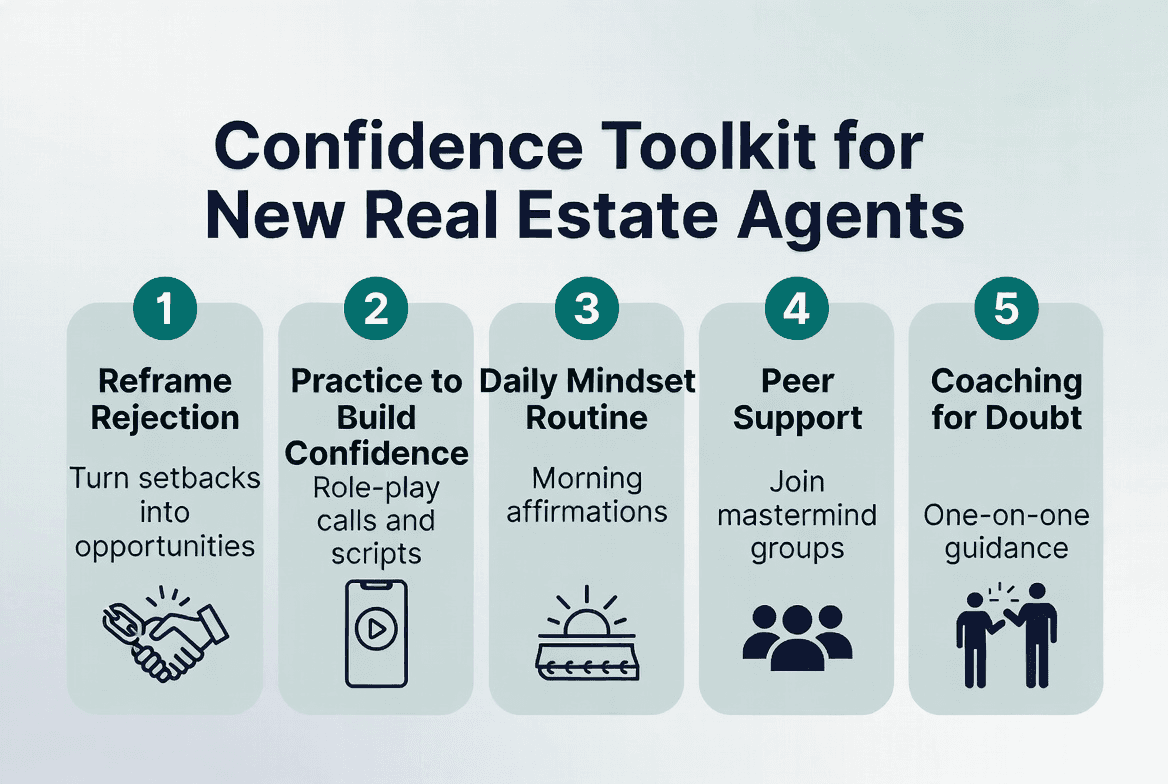
Step 1: Reframe Rejection Don’t see “no” as failure. Most rejections are about fit, not you—focus on finding the right clients.
Step 2: Practice to Build Confidence Record calls, role‑play with mentors, do mock showings, and celebrate small wins to grow steadily.
Step 3: Daily Mindset Routine (10 min) Use affirmations, write down goals, and visualize success to stay positive and motivated.
Step 4: Find Peer Support Join accountability groups, attend team meetings, and connect with mentors to avoid isolation.
Step 5: Get Coaching for Doubt Imposter syndrome is normal—talk to mentors, lean on peers, or hire a coach for guidance.
“It’s harder than it looks” — many first‑year agents admit the emotional rollercoaster is the toughest part.
The 4Ps of Marketing & Value Positioning
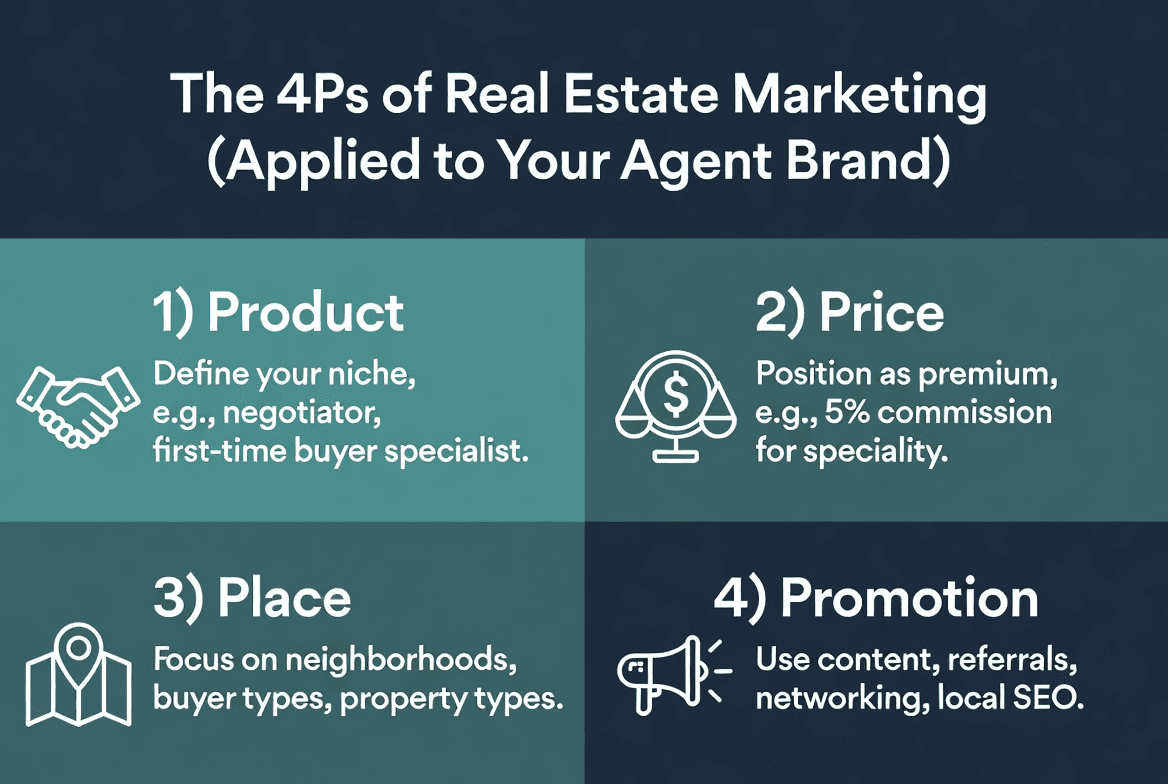
Mistake 7: Competing on Price Instead of Value
What New Agents Do Wrong
Compete on commission rates instead of a unique value proposition ("I'll work for 3% instead of 5%!")
Spread energy across all property types and price ranges (generalist = mediocre)
Fail to identify the 20% of activities that generate 80% of results
Underprice services to win business (race to the bottom)
Why It Matters
Agents who own their value and focus strategically outperform those chasing every deal. Discounting your commission signals that your value is low. Specialization signals mastery.
How to Avoid It
Step 1: Identify Your Power Activities Track commissions and find the 20% of clients or tasks that bring 80% of income. Focus only on those.
Step 2: Build Expertise in Your Niche Write, network, and share insights in your chosen niche. Specialists earn more because they deliver more.
Step 3: Position Yourself as a Specialist Don’t say “I sell everything.” Say “I’m the go‑to agent for first‑time buyers in East Vancouver.”
Step 4: Focus on Relationships & Referrals Deliver great service, ask for referrals, and nurture connections with lenders, inspectors, and past clients.
Step 5: Emphasize Transformation, Not Price Show how you save clients money or stress. Value beats commission rates every time.
What Successful Agents Do Differently
Agents who thrive consistently:
Agents who survive year one and thrive consistently apply these 7 strategies:
Plan financially → Apply the 3-3-3 rule (emergency savings, mortgage reserves, market knowledge)
Build a personal brand → Define a specific niche (not generalist)
Master time management → Apply the 80/20 rule (80% client-facing, 20% admin)
Choose the right brokerage + secure a strong mentor → Not going solo
Execute disciplined follow-up → CRM-driven, consistent, warm-lead focused
Address mindset barriers → Proactively tackle fear, rejection, and imposter syndrome
Focus on value, not price → Position as specialist, build trust, command premium rates
RealtyCourse students complete a 10‑week program that covers business planning, niche definition, mentorship, compliance, and exam prep—launching their careers prepared and confident.
Regulatory Compliance & BC‑Specific Obligations.
Key Rules Under RESA & BCFSA Oversight:
Disclose Material Information (Rules s.30(f)) You must disclose known defects, liens, easements, or transaction issues. Failure can lead to penalties of $17,500+.
Maintain Client Confidentiality: Client information must be protected during and after agency relationships. Breaches can result in discipline or lawsuits.
Avoid Dual Agency (Rules s.63‑64) Dual agency is generally prohibited in BC, except in remote/rural areas where no other agent is available. Mishandling leads to discipline.
Follow Lawful Client Instructions (Rules s.30(b)) You cannot conceal defects or falsify documents. Refuse unethical requests and report misconduct to BCFSA.
Ensure Advertising Compliance All ads must clearly show your brokerage name, licensee name, and PREC number.
Conclusion
Becoming a successful real estate agent in BC isn’t about luck; it’s about avoiding predictable mistakes. With a solid financial runway, a clear niche, disciplined time management, the right brokerage and mentor, consistent follow‑up, and a value‑driven brand, you can turn a risky first year into a stable, growing career. Use these seven frameworks as your roadmap, not just advice.
FAQs
How long does it realistically take to make a full‑time income as a new agent in BC?
Should I start part‑time or quit my job to become a full‑time agent?
Is joining a real estate team better than starting solo as a new agent?
In this Article

This article is Written By
Samir Nathwani
A dedicated professional committed to supporting educational progress, program development, and learner success across various career pathways.


