





Key Takeaways |
|---|
|
Property managers won't admit it: You already know licensed PMs earn way more. You already know it's a steady income that doesn't care about market crashes. So why haven't you done it?
Because you think it's too complicated. Too expensive. Too connected. You're wrong.
The truth? Four steps. $1,500. Six months. That's the only barrier standing between you and $10–$20 monthly recurring income.
Right now, you're either stuck at $44k, feeling trapped, or earning commission and constantly anxious. Licensed PMs aren't. They're building real wealth.
Here we’ll show the exact pathway, the mistakes that cost thousands, and why this matters right now. No fluff. No gatekeeping. Just what you actually need.
Regulatory Reality: Why Property Management Licensing Matters in BC
What BC Law Actually Says
Under British Columbia's Real Estate Services Act (RESA), the BC Financial Services Authority (BCFSA) requires any person managing rental properties for payment to hold a license. This isn't optional. This isn't a technicality. It's the law, and claiming you didn't know isn't a legal defense.
Real BC Cases Show What's at Stake
In 2025, BCFSA issued penalties to multiple property managers for operating without a license:
BCFSA isn't bluffing. Recent cases:
Peter Chu: $75,000 penalty + $5,000 costs (unlicensed for 8 years)
Rena Liang: $50,000 penalty (misconduct)
O'Reilly & Brynelsen: $100,000 each (disclosure violations)
The Pattern Is Clear
These aren't small fines. These are penalties of $50,000 to $100,000+. And these are just the publicly reported cases. BCFSA's message is unmistakable: violations are expensive, and enforcement is active.
What Property Management Activities Require a License?
BC law says you need a license if you do ANY of these for a property owner (and they pay you):
Collect rent from tenants
Screen tenants (run background checks, credit checks, check references)
Negotiate lease agreements on the owner's behalf
Coordinate maintenance (arrange repairs, work with contractors)
Handle security deposits (collect, hold, return them properly)
Advertise rental properties (post listings, show units)
Do just one of these? You need a license. The law doesn't say "collect rent AND screen tenants"—it says any of these activities require licensing.
Beyond the Fines: Other Consequences
Financial penalties are just the beginning. Operating unlicensed also exposes you to:
Civil liability: Property owners can sue you for damages
Criminal prosecution: Serious violations can result in criminal charges
Industry bans: Repeat offenders face 5+ year bans from the industry
Loss of credibility: Once penalized, your reputation in the industry is damaged
Who Gets a Pass? (Only 3 Situations)
BC law has exactly three exceptions where you DON'T need a license:
The 3 Exceptions (Only These)
You own the property (25%+ ownership) and manage it yourself
You're an employee of a property owner or licensed manager
Strata owner in a self-managed strata (rare)
Everything else = you need a license.
If your situation doesn't fit those three exceptions, you legally need a BCFSA license. The penalty for not having one? $50,000 to $100,000+ based on recent enforcement cases. The risk? Lawsuits, criminal charges, industry bans. The solution? Get licensed in 6–12 months through an approved course.
How to Get Your Property Management License in BC: The 4-Step Pathway
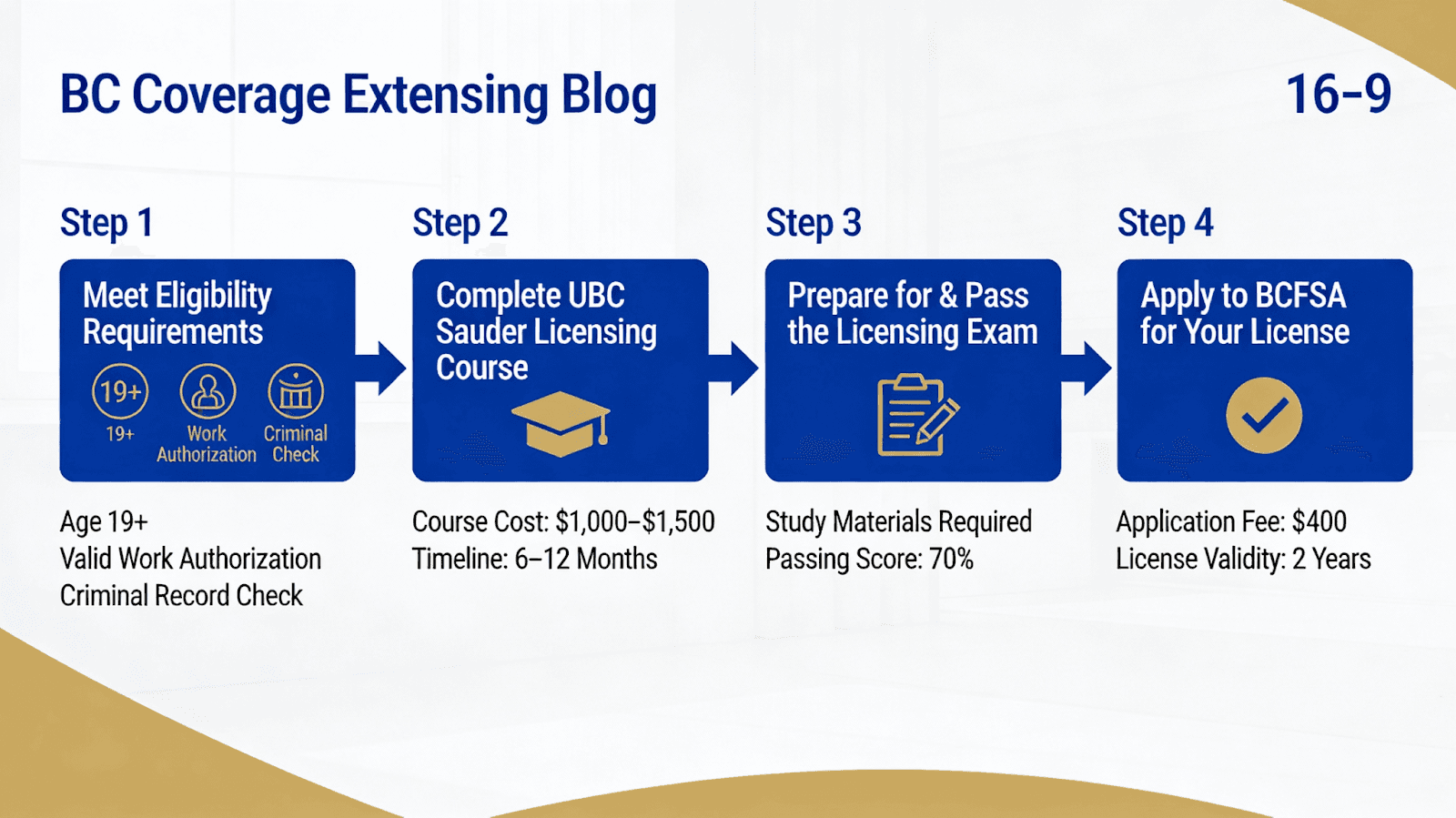
Getting licensed in BC is straightforward, but requires commitment. Here's the complete path:
Step 1: Meet Eligibility Requirements
You must be 19+, have work authorization in Canada, pass a criminal record check (within 90 days), and meet reputation and suitability criteria. This is the gateway—ensure your background is clean before investing time in the course.
Step 2: Complete the UBC Sauder Licensing Course (Mandatory)
The BCFSA-recognized course is administered through UBC Sauder School of Business. You can choose online or in-person formats, depending on your schedule. Most students complete the course in 6–12 months depending on pace, with a cost of $1,000–$1,500.
The curriculum covers essential knowledge: the fundamentals of the Residential Tenancy Act (RTA), contract law and lease agreements, building maintenance basics, RESA compliance, tenant-landlord rights and obligations, and financial management for properties. This isn't busy-work—every topic directly applies to your daily PM responsibilities.
Step 3: Prepare for & Pass the Licensing Exam
The exam is rigorous and pass/fail. Study resources are available through UBC and BCFSA, but preparation is critical. This is where realtycourse.ca's tutoring and coaching make a difference—our insider knowledge of the exam content, combined with proven study strategies, helps you pass on your first attempt. We've trained over 10,000 students to do exactly that.
Step 4: Apply to BCFSA for Your License
Submit your exam proof, criminal record check, application fee, and wait for BCFSA review and approval. Once approved, your license is valid for 2 years and must be renewed. The entire process takes 6–12 months from start to finish and requires an investment of $1,000–$1,500.
The Financial Upside: Salary Ranges & Career Growth in BC Property Management
Property management is not a scheme to get rich quick but it is all about stable, recession-resistant, steady income - something transaction-based real estate sales can't match.
BC Salary Breakdown (2026) (Location & Specialization Specific):
Role | Entry-Level | Median/Experienced | Senior/CPM |
|---|---|---|---|
Residential PM | $44,660-$52,000 | $65,000-$82,000 | $100,000-$142,000+ |
$54,000+ | $82,000-$120,000 | $142,216+ | |
$65,000+ | $100,000-$140,000 | $150,000+ |
Why Licensed PMs Earn More:
Command premium fees: Licensed property managers charge 8-12% of the monthly rent per property. Unlicensed managers can't charge premium rates—they're not legally recognized. Example: On a $2,000/month rental, a licensed PM earns $160–$240 in management fees alone. Unlicensed competitors earn zero because they can't legally operate.
Access larger, institutional portfolios If you are licensed, PM your clients will be property owners and institutional investors who refuse to work with unlicensed managers. Legal liability and regulatory backing. A portfolio of just 50 properties generates $10,000–$20,000 monthly in recurring revenue—completely independent of market cycles or sales ability.
Client trust premium from BCFSA backing Clients pay more for licensed managers because BCFSA backing means legal protection, compliance, and accountability. This trust premium allows licensed PMs to command higher fees and longer contracts.
Specialization opportunity: Licensed status opens doors to high-paying specializations:
Commercial properties: 12–15% fees (vs. 8–10% residential)
Luxury residential: 10–12% fees + premium add-ons
Multi-unit buildings: 6–8% fees on larger portfolios
Residential-only unlicensed competitors can't access these markets.
Income Growth Factors:
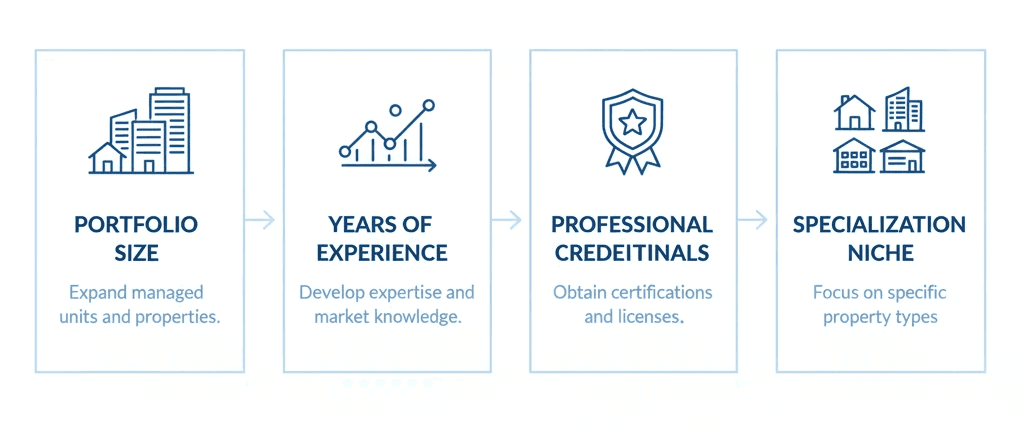
Your income grows with four key factors:
Factor 1: Portfolio Size
10 properties: $800–$1,200/month
25 properties: $2,000–$3,000/month
50 properties: $10,000–$20,000/month
100+ properties: $20,000+/month
Factor 2: Years of Experience
Year 1: Base salary establishment
Years 3–5: 25–40% salary increase (expertise commands higher fees)
7+ years: Top-tier rates and selective client base
Factor 3: Professional Credentials
CPM (Certified Property Manager) credential adds $50,000–$60,000 annually to your earning potential because:
Demonstrates expertise (clients trust you more)
Justifies premium fees (8–12% vs. standard 6–7%)
Opens access to institutional clients (larger portfolios)
Factor 4: Specialization Niche
Residential standard: 8–10% fees
Commercial: 12–15% fees (40% higher)
Luxury residential: 10–12% fees + premium services
Mixed portfolios: Highest earning potential (diversified income)
Note: These earnings ranges are typical for licensed PMs in BC but vary by individual. Actual income depends on your client base, market demand, portfolio quality, business efficiency, and pricing strategy. This is educational information, not a guarantee of earnings. |
PROFESSIONAL CREDENTIALS: License vs. CPM, ARM, CAM
Advance Your Career: License vs. Advanced Certifications
Your BCFSA license is legally mandatory. It's your baseline. But certifications accelerate your career, increase earning potential, and differentiate you from competitors.
Certification | Requirement | Cost | Time | Target Role | Earning Impact |
|---|---|---|---|---|---|
CPM (Certified Property Manager) | 3+ years experience +coursework | ~$13,700 | 12–18 months | Senior manager, large portfolios | $142K+ annually |
ARM (Accredited Residential Manager) | Entry-level credential | ~$1,500–$2,000 | 4–8 weeks | Residential focus | +$15K–$25K annually |
CAM (Certified Apartment Manager) | 12 months experience + 40+ hours coursework | ~$800–$1,200 | 3–6 months | Apartment community manager | +$10K–$15K annually |
CBO (Certified Building Operator) | Maintenance background preferred | ~$600–$900 | 2–4 weeks | Maintenance and operations | +$5K–$10K annually |
Which Path Should You Take?
Path A: Residential Focus
Get BCFSA license (6–12 months)
Gain 1–2 years experience in residential
Pursue ARM or CAM (3–6 months)
Later: CPM for senior roles
Path B: Commercial Focus
Get BCFSA license (6–12 months)
Gain 2–3 years experience in commercial
Pursue CPM (12–18 months)
Target portfolio > 100 properties or institutional clients
Our Recommendation
Get BCFSA licensed first. Gain 2–3 years of hands-on experience. Then pursue CPM if you want:
Premium fees (12%+ vs. 8–10%)
Executive-level opportunities
Institutional portfolio access
Highest earning potential ($142K+)
MODERN TOOLKIT: Technology for Scaling Your BC Property Management Business
Tech Stack Essentials: Software That Scales Your Portfolio
Why Manual Systems Fail:
Manual systems (spreadsheets, paper records, email threads) create:
Compliance risks (no audit trail for BCFSA)
Inconsistent record-keeping
Data loss (human error)
Slow operations (can't scale)
Professional property management software is mandatory at 10+ properties.
BC-Focused Solutions:
Software | Best For | Key Features | Cost |
|---|---|---|---|
Mi Property Portal | Residential, BC compliance | LTB forms, BC templates, local support | ~$50–$150/month |
AppFolio/Buildium | Growing portfolios (10–100+ properties) | AI automation, tenant portal, reporting | ~$200–$500/month |
Yardi | Commercial, institutional (100+ properties) | Enterprise accounting, compliance reporting | ~$300–$1,000+/month |
Google Workspace | Maintenance background preferred | NOT compliant for record-keeping | ~$6–$18/month |
What Features Matter?
Compliance-ready: Built-in BC RTA templates and reporting
Audit trail: BCFSA can review all transaction records
Tenant portal: Online rent payment reduces delinquencies
Integration: Connects to accounting software and banking
Mobile access: Manage properties on the go
Reporting: Generate financial reports for owners
Key Investment Priority
Invest in software that:
Ensures BC compliance
Scales with your portfolio
Reduces manual work
Creates audit-ready records
The software cost ($200–$500/month) pays for itself in operational efficiency and reduced legal risk.
Conclusion
Getting licensed is the single smartest business decision you'll make. Six months. $1,500. Four steps. That's your investment to earn $10K–$20K monthly—independent of market crashes, commissions, or sales ability. Licensed PMs don't wonder, "Is there more?" They build wealth. They're trusted. They scale. The pathway is clear. BCFSA backing is robust. The earning potential is real.
Your next step: Take the free trial at BC School Of Real Estate You get licensed 4x faster and land jobs at top BC brokerages.
FAQs
How much do property managers make in BC?
Do you need a license to be a property manager in BC?
What is the best certification for property management?
How much does a CPM certification cost?
What is the hardest part of property management?
In this Article

This article is Written By
Samir Nathwani
A dedicated professional committed to supporting educational progress, program development, and learner success across various career pathways.


