





Key Takeaways |
|---|
|
If you're considering a strata management career in BC, you need answers to three questions before anything else:
Do I actually need a license?
How do I get one?
Is it worth my time and money?
The short answers: Yes. Through UBC Sauder and BCFSA. And with vacancies across BC and salaries climbing past $70,000-$80,000 per year for experienced managers — yes, very much so.
There are always bigger questions — eligibility requirements, realistic timelines for busy adults, what the exam is actually like, and what nobody tells you about day-to-day strata work.
Here, we've covered all of it — BC-specific, 2026-updated, and straight to the point
What Is a Strata Manager — and Who Legally Needs a License?
A strata manager looks after the daily operations of a condo or townhouse community, making sure the building and shared spaces run smoothly under BC’s Strata Property Act. A rental property manager, on the other hand, deals with individual landlords and tenants, following different rules.
Here's the critical legal point: BC was the first province in Canada to require licensing for anyone providing strata management services for compensation. This mandate falls under the Real Estate Services Act (RESA), regulated by the BC Financial Services Authority (BCFSA).
Who is exempt from licensing:
Self-managed strata corporations (owners managing their own building)
Caretakers who don't make management decisions
Some owner-developers during the development period
Step-by-Step: How to Get Your BC Strata Management License in 2026
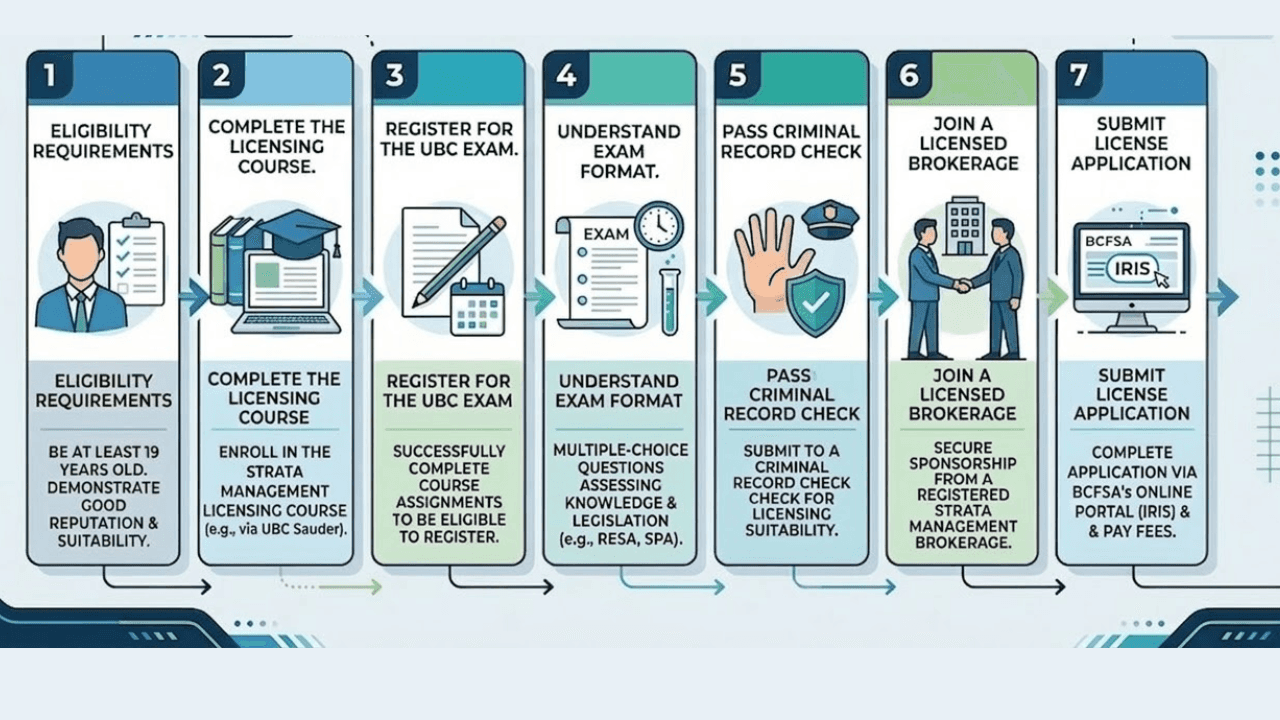
Here is the process as of 2026, confirmed against BCFSA and UBC Sauder requirements.
Step 1 — Meet Eligibility Requirements: You must be 19 or older, have a good reputation (BCFSA reviews criminal and financial history), and meet English language proficiency — either through a CELPIP-G Level 7 score or acceptable academic records.
Step 2 — Enroll in the Only Approved Course: The UBC Sauder Strata Management Licensing Course is the sole approved pathway in BC. It's a self-paced blended program covering strata governance, financial management, the Strata Property Act, dispute resolution, and building operations.
Step 3 — Pass the Licensing Exam: 100 questions. 3 hours. You need 70% or higher to pass. First-attempt strategy matters here — structured exam prep significantly improves your odds.
Step 4 — Get a Criminal Record Check: Must be dated within 90 days of your BCFSA application.
Step 5 — Join a Licensed Strata Brokerage: You cannot operate independently. Every licensed strata manager must work under a managing broker at a licensed brokerage.
Step 6 — Apply via BCFSA IRIS Portal: Submit your application with photo ID and pay the licensing fees (~$1,800 covers your first 2-year cycle).
Step 7 — Optional: Complete the Applied Practice Course: At $875, this BCFSA course bridges the gap between theory and real-world portfolio management. Highly recommended for career changers and beginners.
Full Cost Breakdown
Item | Approximate Cost |
|---|---|
UBC Sauder Strata Course | $1,450 |
Exam Fee | Included |
Criminal Record Check | |
BCFSA License (2-year cycle) For new license applications received on or after April 1, 2026 | $1630 |
Total | ~$3,800–$4,200 |
How Long Does a Strata Management Course Take?
Most dedicated students complete the UBC Sauder course and receive their BC strata management license within 3–6 months.
Here's the realistic breakdown, straight from BCFSA:
Minimum pace: 10 weeks (1–2 assignments per week)
Time per assignment: 10–12 hours — manageable around a full-time job or family
Maximum allowed: 1 full year from your registration date
Average time to become fully licensed: 6 months, based on completing one assignment per week
The course is entirely self-paced and blended — meaning you set your own schedule. There are no fixed class times, no commuting, and no pressure to keep up with a cohort. That's exactly why it works for career-changers, parents, and working professionals across BC.
Already licensed in BC real estate? If you currently hold a trading services or rental property management licence, you may qualify for the Strata Management Supplemental Course instead — a shorter pathway with 12 assignments, a 2-hour exam, and a reduced fee of $775. Ask BCFSA or our team whether you qualify.
Common confusion: CPM (Certified Property Manager) is a US designation offered by IREM. It is not required in BC and is not part of the BCFSA licensing pathway. Don't let US-focused content mislead you. |
Ready to see if classes fit your schedule? View Upcoming Classes
What Skills Do You Need to Be a Strata Manager?
Strata management is one of the most multi-disciplinary roles in BC real estate. Here's what the job actually demands:
Core Technical Skills
Strata Property Act & bylaw interpretation — you'll read and apply these daily
Financial auditing, levy collection, budget planning — every strata corporation has a contingency reserve fund you'll oversee
Building maintenance oversight & defects reporting — from elevators to envelope issues
Insurance procurement & risk management — one wrong policy gap can cost millions
Legal dispute resolution — from neighbour noise complaints to Civil Resolution Tribunal filings
Soft Skills (Where Burnout Actually Begins)
Conflict resolution — think UN peacekeeper-level diplomacy with owners who have strong opinions about their parking stall
Mental health boundaries — the profession has a real burnout problem; 43% of practitioners report high stress
Clear written and verbal communication — especially valuable for ESL and newcomer professionals entering the field
Emerging 2026 Skills
Smart building technology literacy (IoT, automated systems)
EV charging infrastructure planning (2026/2028 provincial mandate deadlines approaching)
Digital voting systems and e-governance for strata AGMs
Sustainability and ESG awareness for building operations
Strata Manager Salary in BC — And Is There a Shortage?
Average hourly (BC) ~$33/hr | Monthly take-home | Active vacancies in BC 100–200 |
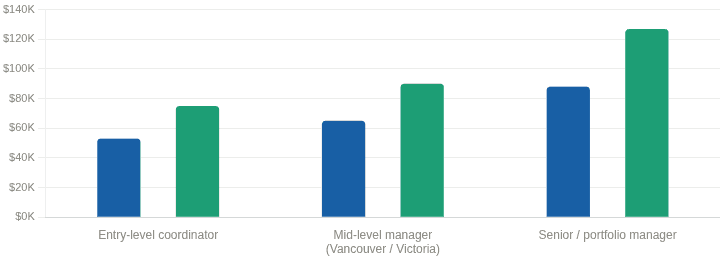
The demand is real — and so is the opportunity. Enrol in the Strata Course
The Real Downsides (and How Proper Training Handles Them)
No guide worth reading ignores the hard parts.
The genuine challenges of strata management:
After-hours emergency calls (burst pipes don't respect business hours)
Complex and frequently changing legislation (depreciation report mandates, rental restriction bylaw changes, EV planning requirements — all shifting between 2024–2026)
Special levy disputes — owners don't enjoy surprise $50,000 assessments, and they'll let you know
How training closes the gap: The UBC Sauder course covers dispute-resolution frameworks and legislative updates. Pairing that with ongoing CPD (Continuing Professional Development) means you enter the role equipped rather than blindsided. The professionals who struggle are the ones who treated their licensing exam as the finish line — it's actually the starting line.
Conclusion
Getting a strata management license in BC is a clear, structured process — and it’s worth it. If you meet the eligibility requirements, complete the UBC Sauder course, pass the exam, and join a licensed brokerage, you’ll be on your way to a rewarding career. With salaries rising, vacancies across the province, and growing demand for skilled managers, investing the time and money into licensing pays off.
FAQs
How to get a BC strata management license?
How long does it take to become a strata manager in BC?
Is strata management a good career in BC in 2026?
What are the downsides of strata?
In-person vs. online strata management courses — which is better?
Can I take the strata course with no real estate experience?
What's the difference between strata and rental property management licensing?
In this Article

This article is Written By
Samir Nathwani
A dedicated professional committed to supporting educational progress, program development, and learner success across various career pathways.


