





Key Takeaways
|
100 questions. 3 hours. 2 attempts. That's all you get.
If you don't pass the BC real estate licensing exam within those two tries, you go back to the beginning. Full UBC course. Full cost. Full wait.
Most students walk in underprepared because nobody gave them a honest answer on how to actually study for this exam.
Here's that answer — simple, clear, BC-specific.
Read it once. Follow tips.
Understand Exactly What You're Walking Into
Before you study a single page, know what the exam looks like.
Exam detail | What it means for you |
Format | 100 multiple-choice questions |
Time allowed | 3 hours (1.8 minutes per question) |
Passing grade | 70% — that's 70 correct answers out of 100 |
Attempts allowed | 2 only. Fail both? Re-enroll in the full UBC course |
Wait after first fail | 90 days before your second attempt |
Exam frequency | 4 times per year at centers across BC |
Computerised option | UBC's CEC at the Vancouver campus — book 6+ weeks in advance |
Course provider | UBC Sauder School of Business — Real Estate Division |
Regulatory body | BC Financial Services Authority (BCFSA) |
The Real Estate Council passed a motion raising the passing grade for all real estate licensing examinations to 70%, effective January 1, 2017 — a 5% increase introduced specifically to raise entry standards and increase professionalism among licensees. This wasn't a minor admin update. It was a deliberate move to make the credential harder to earn.
That decision came from the top of BC's regulatory body. It means the bar you're being held to was consciously set higher — because the standard of who gets licensed in BC matters.
You don't want to be the one who finds that out the hard way.
What Does the Exam Actually Test?
Most study guides won't tell you this: while UBC Sauder states that exam questions are generally weighted evenly across major chapter topics, not every topic is equally complex or equally likely to trip students up.
Knowing where students lose marks changes how you should allocate your study time.
Here's a smart way to think about your study priorities:
Topic Area | Why It Deserves Your Focus |
Real Estate Law & Legislation | Dense, high-stakes — regulatory topics receive extra attention |
Agency & Ethics | Heavily scenario-based; updated emphasis in 2025 exam |
Property Valuation & Appraisal | Math-heavy; requires consistent practice |
Contracts & Conveyancing | Rebalanced in 2025 — now carries a stronger focus |
Calculation errors are common; practice is non-negotiable | |
Building Science & Construction | Conceptual — easier to cover efficiently |
Smaller scope; review once, don't over-invest |
Note: According to the UBC Real Estate Division Licensing Exam FAQ, exam questions are generally weighted evenly across major chapter topics. This table reflects recommended station study prioritized on topic complexity and known student difficulty areas — not official exam weighting. Always confirm current exam details at bcfsa.ca.
The top five areas — law, agency, valuation, contracts, and mortgage math — are consistently where students struggle most.
Most students who fail spend equal time on everything. Don't do that.
If you're looking for that kind of structured exam prep, explore our BC real estate licensing courses — built around exactly this kind of focused, outcome-driven learning.
Build a Study Plan You Can Actually Stick To

You don't need to quit your job to pass this exam.
“Amanda Paul, a student, passed her exam on the first try while working full-time and caring for her young daughter — studying at night. As she put it, she genuinely could not have done it without a structured program to guide her. You can read her story and others like it on the testimonials page.”
Here's the plan that works.
The 10–14 Week BC Real Estate Exam Roadmap
Weeks 1–4: Assignments + Active Reading
Complete your UBC Sauder assignments at the allowed pace (max 2 per week — this is a UBC rule, not a suggestion)
Read each chapter once. Don't try to memorise on the first pass. Understand the concept first
At the end of each chapter, write a 3-bullet summary in your own words
Weeks 5–8: Topic Deep-Dives
Focus your energy on the five high-weight topic areas
Minimum 5 hours per week of active study — not passive reading
Work through mortgage math problems every single session (even 5 calculations per day adds up)
Flag every topic you don't feel confident about. These become your Week 9–10 priority
Weeks 9–10: Mock Exams Only
Stop reading. Start testing.
Sit full timed mock exams: 100 questions, 3-hour clock, no interruptions
Target 80% on practice tests — not 70%. You want a buffer for exam day nerves
Review every wrong answer. Not to memorize it — to understand why you got it wrong
Final Week: Drill Your Weak Spots
Take your 3 worst-performing topic areas from mock exams and drill those only
If you're in a structured program with a mentor or instructor — this is the week to use that access
Book your exam at least 6 weeks out if you're using the UBC Computerized Exam Center
Working Full-Time? Here's How to Make It Work
You don't need 4-hour study blocks. You need consistency.
45 minutes per session × 5 days per week = enough to complete the course in 10 weeks while holding a full-time job. |
A few things that help:
Morning sessions beat evening sessions for memory retention. Even 6:30–7:15am before work beats 9–9:45pm when your brain is already tired
The UBC course is chapter-based — each chapter is a self-contained unit. One chapter = one session. Clean and manageable
Don't skip weekends entirely. One weekend session of 90 minutes keeps your momentum and reduces weekday pressure
If You're a Visual Learner
The UBC course manual is dense text. That's just the reality.
If reading walls of text doesn't work for you:
Convert each chapter into a one-page mind map before moving on
Draw agency relationships as simple diagrams (who represents who, and what they owe each other)
Sketch mortgage payment flows — principal, interest, amortisation — as visual charts
Turn legal timelines into visual sequences
Supplementing with video-based instruction that covers the same material in a different format can significantly cut the time it takes to understand complex concepts.
The Study Techniques That Actually Move the Needle
Mock Exams First. Everything Else Second.
If you only take one thing from this guide, take this:
Mock exams are the single most important thing you can do to prepare for the BC real estate exam.
Not re-reading chapters. Not making notes. Mock exams.
Here's why. The UBC exam tests application, not recognition. You can read a definition ten times and still fail a scenario question about it.
But if you've practiced applying that concept under timed conditions, your brain builds a pattern — and that pattern holds on exam day.
Time yourself properly: 100 questions in 3 hours = 1.8 minutes per question. Practice at that pace from week 9 onwards. Don't practice in a relaxed, unlimited-time environment — the real exam doesn't work that way.
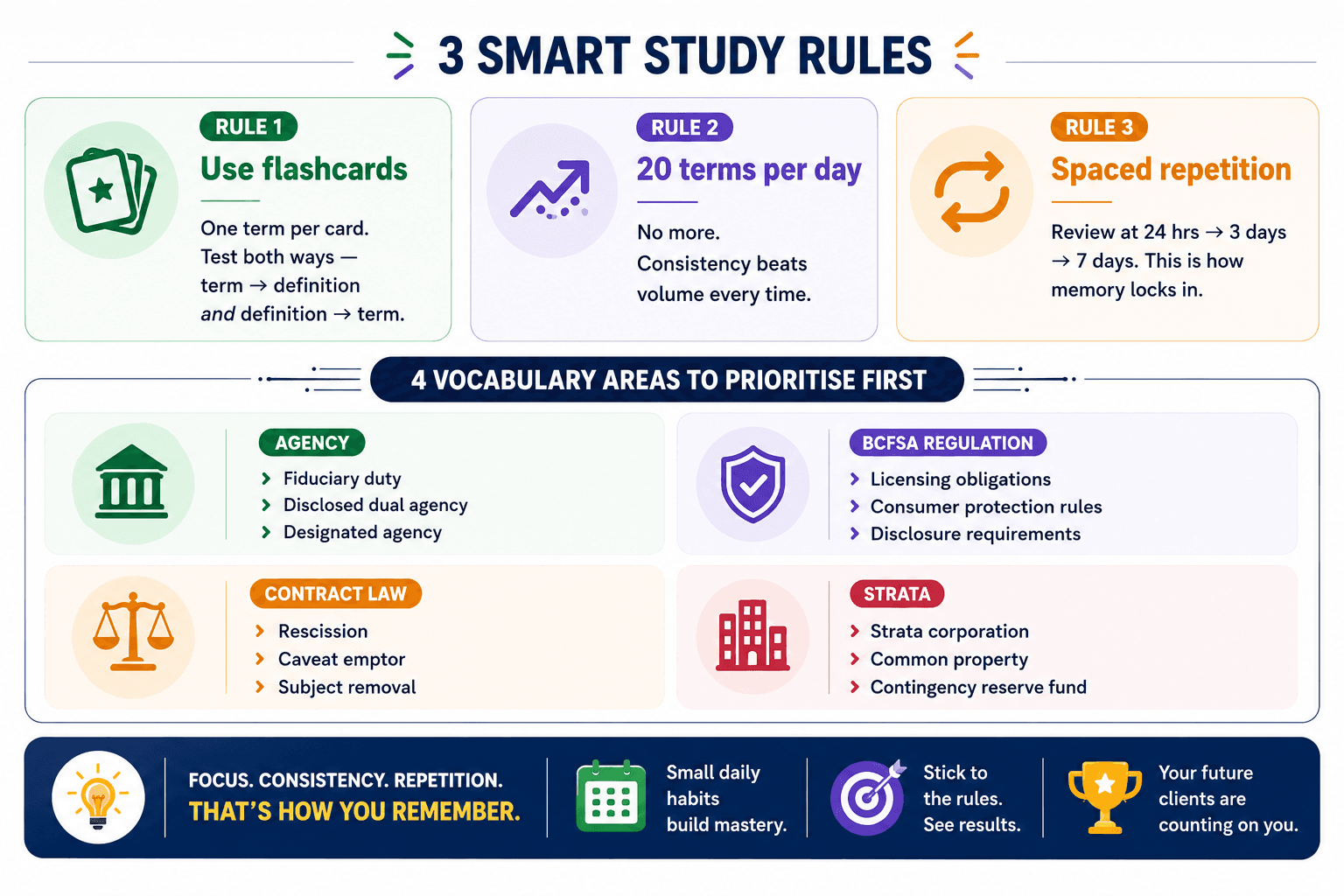
How to Memorize Real Estate Terminology Without Burning Out
The BC real estate exam uses precise legal language. You need to know the terms — but trying to memorize 400 definitions in one sitting is a fast track to giving up.
How to Handle Mortgage Math (Without Hating Your Life)
Math is where most BC real estate students lose marks. Not because it's complicated — because they save it for last, panic, and under-practice it.
The fix: 5 mortgage calculations per study session, every session, from week 5 onwards.
Not 50 calculations on the weekend before your exam. 5 calculations, spread across every session. Distributed practice builds speed. Cramming builds anxiety.
At the exam center, you'll be given scratch paper. Use it for every single calculation — don't try to do mortgage math in your head. The questions are designed to look more complex than they are. Write out each step.
Exam Day Strategy

Don't book your exam until mock scores consistently hit 75%+. Not 70%. That buffer covers nerves, a new environment, and a clock you can't pause. One extra week of drilling costs far less than a second attempt.
On the day:
Arrive 20 minutes early
Skim the full exam first, then go back to answer
Answer what you know first — flag and return to the rest
Use scratch paper for every calculation, no exceptions
Tackling scenario questions: When two answers look equally right, ask — which one better protects the client? BCFSA's entire framework is built on consumer protection, and the exam reflects that consistently.
The 72-hour wind-down:
Day 3 — Final mock exam. Review wrong answers only, then stop
Day 2 — 30 minutes on your weakest topic. Close your notes after
Day before — No studying. Let your brain consolidate
Exam morning — Eat, arrive early, trust your prep
Why a Structured Course Makes the Difference
The UBC manual is written for comprehensiveness — not exam prep. It covers everything but won't tell you where students lose marks or how to apply concepts under timed pressure. That's the gap a structured course fills.
What to look for:
BC-specific content — not recycled from other provinces
Timed mock exams that mirror the real UBC format
Live instructor access — not just pre-recorded videos
Support that runs through your exam date, not just your enrolment period
Conclusion
You've Got Everything You Need — Now Use It. The BC real estate exam isn't easy. But it's not unpredictable either. You now know the format, where students lose marks, how to build a study plan around a full-time life, and exactly what to do in the final 72 hours before you walk in.
The students who pass on their first attempt aren't smarter than the ones who don't. They're just more prepared — and they didn't prepare alone. Mock exams over re-reading. Consistency over cramming. Focused study covers everything equally. These aren't complicated ideas. But they make all the difference between passing the first time and starting over.
If you're ready to stop guessing and start preparing with a clear structure, live support, and timed mock exams built specifically for the UBC Sauder format — BC School of real estate has helped over 10,000 students get there.
In this Article

This article is Written By
Samir Nathwani
A dedicated professional committed to supporting educational progress, program development, and learner success across various career pathways.


