





Key Takeaways
|
You're about to enroll in mortgage broker licensing, and nobody's giving you a straight answer to the one question that actually matters — what you'll be earning a year from now. Every site gives a different number, and none of them mention there's no paycheque in this career, just commission, paid only when a deal funds.
Here's the honest mortgage broker salary BC numbers: most new brokers earn $32K–$55K in year one while building a pipeline from nothing. The $100K+ range is real — it just takes time and the right foundation to get there.
Here's the full breakdown, stage by stage.
How Much Does a Mortgage Broker Make in BC?
Mortgage brokers in BC earn 0.5%–1.2% commission per closed deal rather than a fixed salary, putting most active brokers between $60,000 and $120,000 annually. The table below pulls five sources — Government of Canada Job Bank, Glassdoor, Indeed, and PayScale — so you're seeing real reported numbers, not one site's average.
The Salary Data Across Sources (2025–2026)
No single platform gives you the full picture. Here's what five credible sources report for BC mortgage broker income, as of 2025–2026, starting with the Government of Canada Job Bank:
Source | Low | Typical Range | High |
$50K (~$24/hr) | — | $149K (~$72/hr) | |
$54K | $54K–$157K | $210K | |
— | $86K avg | — | |
— | $60K | — | |
$49K | $64K avg | $103K |
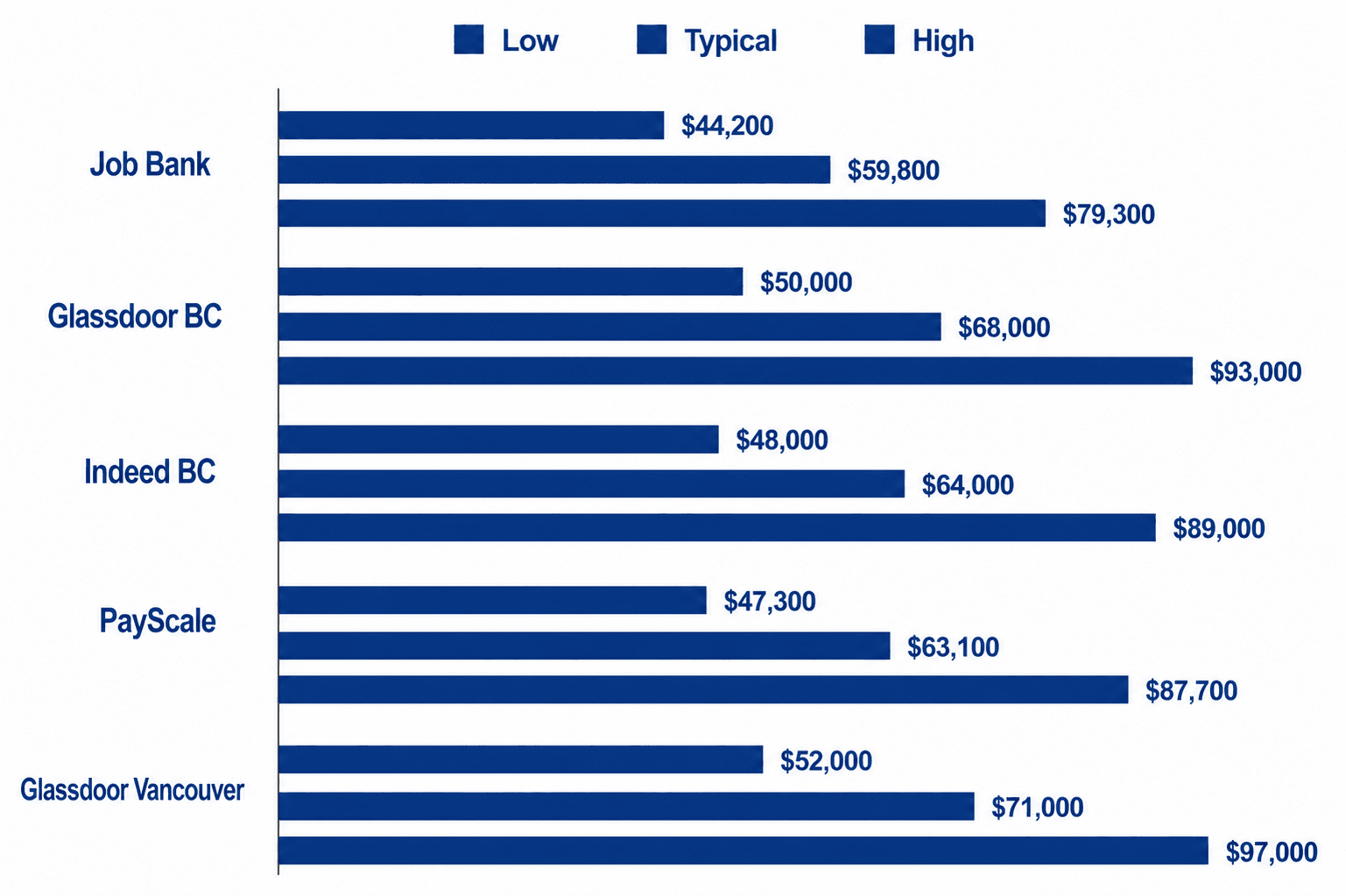
Note in copy: ZipRecruiter figures ($129K average) are excluded from the table with an explicit explanation — their methodology aggregates US job posting data and applies it to Canadian markets, which inflates BC figures significantly. This is the "why salary sites disagree" moment, addressed transparently.
Why Do Salary Sites Show Such Different Numbers?
Three reasons explain most of the variation:
Commission income is self-reported and highly variable. A broker who closed 40 deals self-reports very differently from one who closed 8. Both count as ‘mortgage brokers’ in the data.
Some platforms pull US data into Canadian results. ZipRecruiter is the clearest example. US mortgage markets, average home prices, and commission structures differ significantly from BC.
Top-earner outliers skew averages. A handful of brokers who own equity in their brokerage and profit from junior brokers' deals pull reported averages sharply upward. This ceiling is real — but it reflects ownership, not brokering alone.
What the data actually tells you: most active BC mortgage brokers who are not in their first year earn between $60,000 and $120,000. That's the honest working range.
How Mortgage Brokers in BC Get Paid
Before you can make sense of the salary data, you need to understand the payment structure. Mortgage brokers in BC do not earn a fixed salary. Income comes entirely from commissions paid by lenders when a mortgage closes.
The Commission Structure Explained
Lenders pay brokers a finder's fee when a mortgage closes — the borrower typically pays nothing
Rate: 0.5%–1.2% of the mortgage amount; 5-year fixed terms tend to pay at the higher end
In BC, commission amounts are regulated and must be disclosed — governed by BCFSA
Worked example: $600,000 mortgage (near BC median) × 0.85% = ~$5,100 per funded deal
What Will You Actually Earn in Your First Year?
On a $600,000 mortgage at a 0.85% commission rate, a BC broker earns about $5,100 gross per funded deal — before the brokerage split and operating expenses come off the top. The table below breaks down gross commission across different mortgage sizes and rates.
Mortgage Size | At 0.5% | At 0.85% | At 1.2% |
$400,000 | $2,000 | $3,400 | $4,800 |
$600,000 (BC median area) | $3,000 | $5,100 | $7,200 |
$900,000 (Vancouver) | $4,500 | $7,650 | $10,800 |
$1,000,000 | $5,000 | $8,500 | $12,000 |
Important: these are gross figures. Your brokerage takes a commission split — which can range from 20% to 50% depending on your agreement, especially as a new submortgage broker. After split and operating expenses (industry average: ~20% of gross commissions), net income is meaningfully lower than the deal-level figures above.
Other Ways Brokers Earn
Beyond upfront commissions, some lenders offer:
Volume bonuses — additional payments for reaching deal thresholds with a specific lender
Trailer fees — small annual payments for as long as the client remains with that lender
Renewal commissions — paid when a client renews with the same lender
These are supplementary, not a primary income source. Build your income projections on funded deal commissions first.
What Will You Actually Earn in Your First Year?
Most new submortgage brokers in BC earn $32,000–$54,000 in their first year, according to ZipRecruiter (December 2025) — well below published career-stage averages. This section covers why that ramp-up happens and what speeds it up, the part most salary guides skip entirely.
The Honest First-Year Picture
Most new submortgage brokers in BC earn below the published averages in year one. That's not a warning — it's a structural reality of commission-based income.
Entry-level data from ZipRecruiter (December 2025) places most new brokers at $32,000–$54,000 in their first year. The lower end of that range reflects the ramp-up period; building a referral network, learning lender relationships, and earning trust with real estate agents takes time.
The application funnel reality is that industry sources estimate that closing 20 funded mortgages per year — the deal volume needed to gross roughly $60,000–$80,000 at BC average mortgage sizes — requires starting 80–100+ applications. Rate shoppers, unfunded approvals, and clients who don't qualify all consume time without generating income. There is no base salary. No retainer. Income starts only when deals close.
One thing students consistently report is the licensing material is more complex than expected. Having structured support makes the difference between passing the first attempt and resitting the exam — which delays the start of your earning timeline.
What Speeds Up Your Ramp?
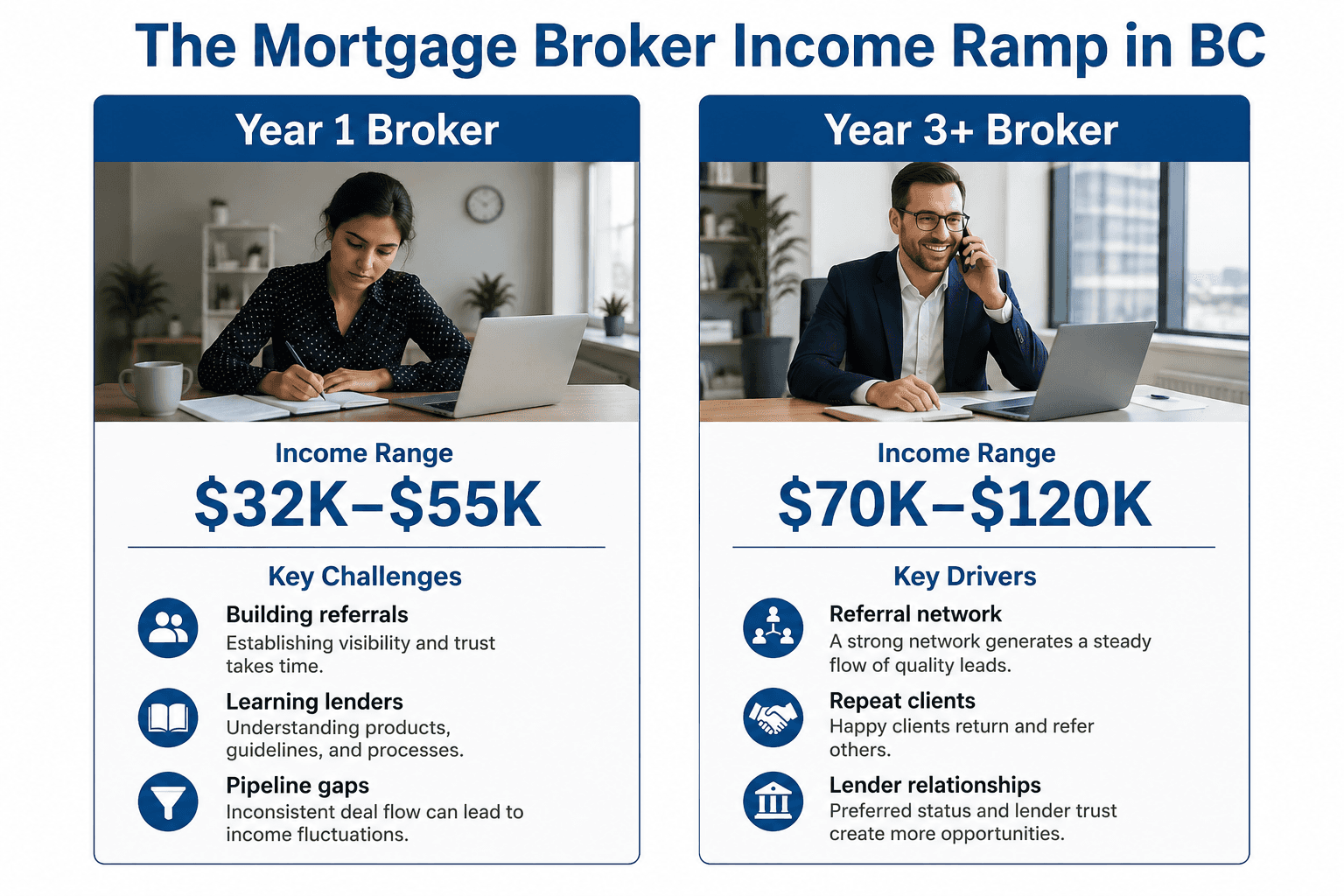
Four factors consistently separate faster-ramping new brokers from those who struggle through year one:
Prior network in finance, banking, or real estate sales. Existing relationships with real estate agents and accountants are the fastest path to early deal flow.
Brokerage size and support structure. Larger brokerages often provide mentorship, lender introductions, and in some cases, lead flow. The tradeoff is a higher commission split.
Full-time commitment. Part-time brokers consistently report lower first-year income. The referral network you need takes consistent, visible presence to build.
Geographic market. Vancouver and the Lower Mainland carry higher average mortgage sizes. The same number of funded deals generates meaningfully more gross commission than in smaller BC cities.
Here what students says :

Mortgage Broker Salary in BC by Experience Level
Career Stage | Typical Income | Annual Deals | Key Variable |
Entry-Level (Years 0–2) | $32,000–$55,000 | 5–15 funded | Network building |
Established (Years 3–6) | $70,000–$120,000 | 20–35 funded | Referral pipeline |
Top Producer (6+ years) | $150,000+ | 40+ funded | Ownership / volume bonuses |
Entry-Level Submortgage Broker: $32,000–$55,000
Years zero to two. You are building your pipeline, working under a registered brokerage, and learning which lenders suit which borrower profiles. Income is highly variable month to month — some months strong, some dry. This is normal, not a signal to exit.
Established Broker with Active Referral Network: $70,000–$120,000
Years three to six. Consistent deal flow from past clients, real estate agents, and accountant referrals. Funding 20–35 mortgages annually at BC's average mortgage sizes puts gross commission in this band before expenses and brokerage split.
Top Producers: $150,000+
Senior brokers, brokerage principals, or those with equity stakes in their firm. Top earners typically also profit from junior brokers' deal flow — it's a business model, not just a brokering volume. The ceiling is real. The timeline to reach it is not short.
What Affects How Much You'll Make
Vancouver vs. Smaller BC Cities
Where you practise in BC has a direct impact on gross commission — even if you close exactly the same number of deals.
Vancouver and the Lower Mainland: average mortgage sizes in the $700,000–$900,000+ range. At 0.85%, that's $5,950–$7,650 per funded deal.
Kelowna, Victoria, Prince George: lower average mortgage sizes, but also lower broker density and competition.
The math: ten funded deals in Vancouver can gross $60,000–$75,000. The same ten deals in a smaller BC city might gross $35,000–$50,000.
Working Under a Brokerage vs. Going Independent
Your brokerage takes a 20%–50% split off every commission, and that variable affects your take-home more than almost any other factor in your first few years. This is the piece most students miss when they look at gross commission figures alone.
All new brokers in BC must start as a submortgage broker — registered under a licensed mortgage brokerage.
The brokerage takes a commission split, which varies widely: 20%–50% depending on your agreement, the support provided, and deal volume.
Going independent later requires registering as a full mortgage broker with BCFSA — higher regulatory responsibility and higher take-home per deal, but no built-in support structure.
Practical implication: if your gross commission on a deal is $5,100 and your brokerage split is 40%, your net before expenses is $3,060. Factor this into your income projections from day one.
How to Get Licensed as a Mortgage Broker in BC
None of the income figures above are accessible without a licence. Here's the pathway.
The Submortgage Broker Path (Where Everyone Starts)
Complete the Mortgage Brokerage in British Columbia course via UBC Sauder School of Business
Pass the exam at 65% or above — two attempts are permitted per course registration
Secure employment with a registered mortgage brokerage before submitting your registration
Register with BCFSA as a submortgage broker — registration fee is $1,500; valid for two years
2026 Regulatory Update — Important for Anyone Starting Now: BC's new Mortgage Services Act (MSA) replaces the Mortgage Brokers Act on October 13, 2026. A new Mortgage Services Licensing Course launches via UBC Sauder on August 4, 2026. If you are starting the licensing process now, confirm with UBC Sauder which course pathway applies to your timeline before enrolling.
Already Licensed in BC Real Estate? There's a Shortcut
If you currently hold a BC real estate licence, or completed a UBC Sauder School of Business real estate services course within the past year, you qualify for the shorter Mortgage Brokerage Supplemental Course rather than the full program.
Confirm your eligibility directly with BCFSA before enrolling — approval must come from the Registrar for certain pathways.
Once you've passed the exam, read our guide on what to do after passing your BC real estate exam — the licensing and brokerage registration steps are nearly identical.
The Bottom Line
The honest range for an active BC mortgage broker: $60,000–$120,000, depending on deal volume, market, and years of practice. Year one will likely sit below that. Year three and beyond, with a referral pipeline in place, can comfortably exceed it.
The income ceiling is real. So is the ramp-up period. Go in with clear expectations about both, and this career has genuine long-term earning potential.
Getting licensed is the first concrete step. Students who pass with structured preparation — rather than working through the material alone — start their brokering career faster. Over 10,000 students have come through BC School Of Real Estate programs, and the mortgage broker licensing material is among the most challenging they encounter. Structured exam prep makes a measurable difference.
Ready to Start Your Mortgage Broker Career in BC?
Explore the Mortgage Broker Licensing Program at Realty Course
FAQs
Why do salary sites show such different numbers for BC mortgage brokers?
How much does a mortgage broker make per deal in BC?
Is a mortgage broker a good job in BC?
In this Article

This article is Written By
Samir Nathwani
A dedicated professional committed to supporting educational progress, program development, and learner success across various career pathways.


